Odisha’s Textile Revolution: From Labour Exporter to Manufacturing Powerhouse
Summary
Odisha is emerging as India’s next textile and apparel hub with ₹20,000+ crore investments, but its biggest strength lies in its migrant workforce powering hubs like Surat and Tiruppur. This article explores the current momentum, future potential, and why cotton farming and supply chain integration are critical for long-term success.
Odisha’s Textile Revolution: From Labour Exporter to Manufacturing Powerhouse
Odisha is quietly positioning itself as India’s next major textile and apparel hub. Backed by policy support, rising investments, and a strong labour base, the state is transitioning from a labour-exporting economy to a manufacturing-driven ecosystem.
The Ground Reality: Odisha Powers India’s Textile Workforce
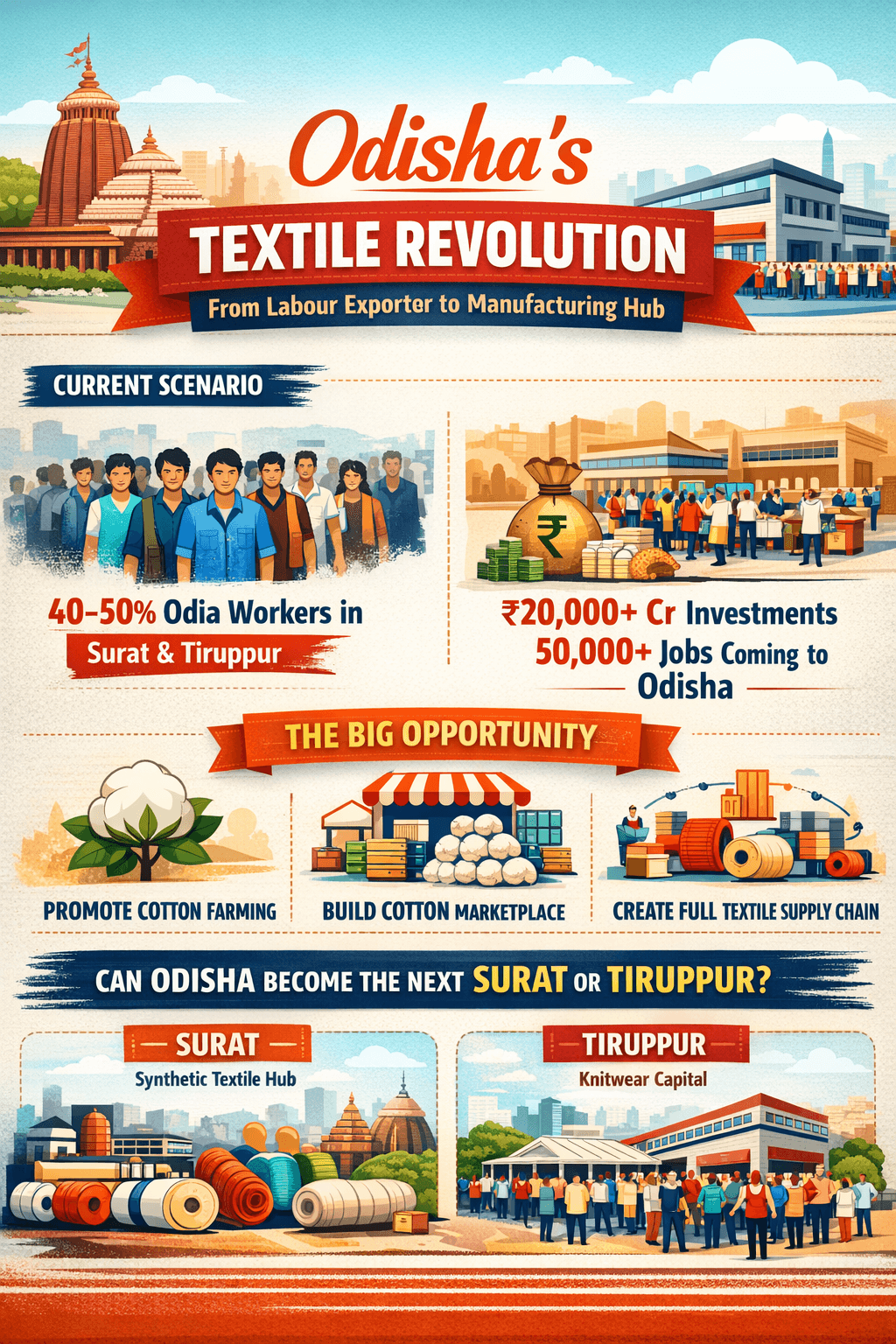
One of the most underreported facts is that if you visit Surat or Tiruppur today, nearly 40–50% of the workforce comes from Odisha.
These workers are employed across garment factories, power loom units, dyeing clusters, and export-oriented textile industries.
- Garment manufacturing
- Power loom operations
- Processing and dyeing
- Export apparel units
This highlights a critical gap: Odisha supplies skilled labour but does not capture the value generated by the textile industry.
Investment Momentum in Odisha
Odisha is now witnessing a surge in textile investments:
- Over ₹20,000 crore investment pipeline
- 50,000+ expected jobs
- Focus on apparel, technical textiles, and integrated textile units
Emerging textile hubs include Khurda, Cuttack, Ganjam, Sambalpur, and Keonjhar.
Learning from Established Textile Hubs
Surat Model
Surat is known for synthetic textiles, strong MSME participation, and integration with petrochemical industries.
Tiruppur Model
Tiruppur is India’s knitwear export capital with deep global supply chain integration and a strong SME ecosystem.
Key lessons for Odisha:
- Cluster-based development is essential
- Export orientation drives scale
- MSMEs are the backbone of the sector
- End-to-end supply chain integration is critical
The Missing Link: Cotton Ecosystem
Despite progress, Odisha lacks a strong cotton-based raw material ecosystem. The state depends heavily on other regions for cotton supply.
Unlocking the Opportunity: Cotton + Textile Integration
1. Promote Cotton Farming
Western Odisha and KBK regions have potential for cotton cultivation. Government support through MSP, irrigation, and training can boost production.
2. Build a Cotton Marketplace
A structured marketplace linking farmers directly with textile units can improve price discovery and eliminate middlemen.
3. Develop Full Value Chain
The ideal textile ecosystem includes:
Cotton → Ginning → Spinning → Fabric → Garments → Export
Currently, Odisha is largely limited to labour-intensive garmenting.
Why Odisha Can Lead India’s Textile Growth
- Large and skilled workforce
- Strategic coastal location
- Lower cost of land and labour
- Strong policy push from the government
Challenges Ahead
- Execution delays in projects
- Lack of ecosystem depth
- Limited MSME financing
- Weak export integration
The Way Forward
- Fast-track textile parks
- Encourage return of migrant workforce
- Launch a dedicated cotton mission
- Support MSMEs with credit and subsidies
- Focus on export-oriented growth
The Big Vision
With the right execution, Odisha can build a ₹50,000+ crore textile economy, generate over 1 lakh jobs, and become Eastern India’s apparel manufacturing hub.
The state has already built the workforce. The next step is bringing the industry home.
Why This Matters for Odisha
Odisha currently exports labour but imports value Textile sector can become largest job creator after agriculture Can reduce migration to Surat and Tiruppur Opportunity to build a ₹50,000+ crore industrial ecosystem Cotton farming can transform rural economy + farmer income Positions Odisha as Eastern India’s manufacturing hub
Source: Odisha Economy
By Ranjan